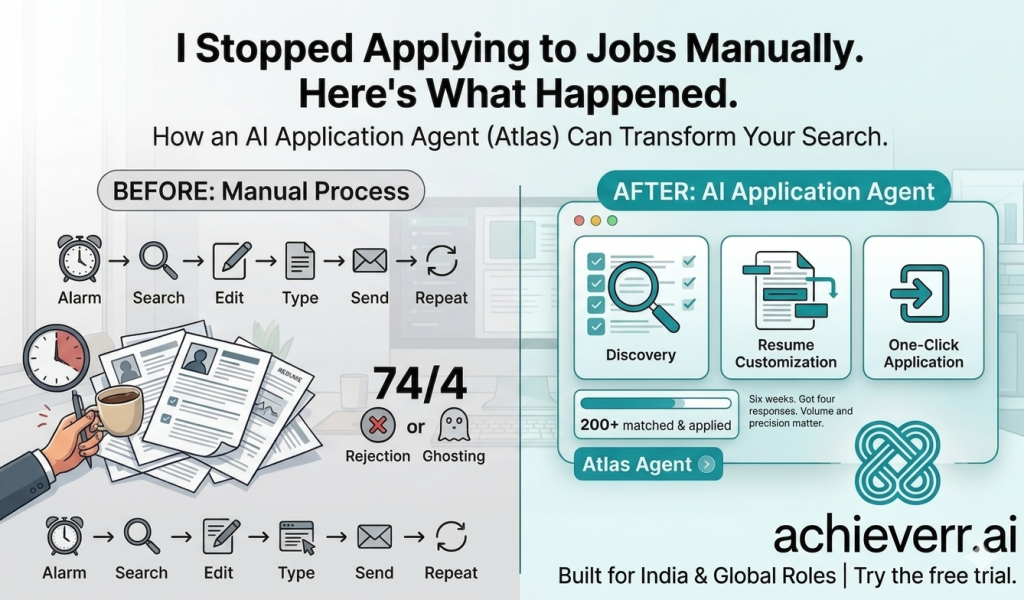
Three months into my job search, I had a routine and it wasn’t working. I’d heard about using an AI job application agent but kept putting it off. Instead I was doing it all manually.
Wake up. Open LinkedIn. Open Naukri. Open Indeed. Spend ninety minutes reading job descriptions that all somehow sounded identical. Customise the resume. Write a cover letter that I was already bored of before I finished it. Hit apply. Repeat.
I applied to 74 jobs in six weeks. Got four responses. Two were rejection emails that arrived so fast they felt automated. One was from a recruiter who ghosted me after a screening call. One turned into an interview.
That math is terrible, and I knew it. I just didn’t know what to do about it.
The problem isn’t effort. It’s scale.
Recruiters who post jobs on LinkedIn can get 300 applications in 48 hours. The ones that make it to a human first get filtered through an ATS applicant tracking software that scores your resume against the job description before anyone reads it.
So if your resume doesn’t have the right keywords for that specific role, it doesn’t matter how good you are. You’re out before you’re in.
What this means practically: the people who get callbacks aren’t always the most qualified. They’re the ones who applied to enough roles, with well-matched resumes, consistently. Volume and precision matter more than most of us want to admit.
That’s a time problem. Customising a resume properly for each application takes 20–40 minutes if you’re doing it right. Apply to 10 jobs a day and you’ve got a part-time job that pays nothing.
What an AI job application agent actually does
I want to be specific here because ‘AI job agent’ gets thrown around to describe a lot of different things.
At the basic end, some tools just auto-fill forms. They pull your resume data and paste it into application fields so you don’t have to. Useful, but not transformative.
At the more sophisticated end and this is where things get genuinely interesting – you have tools that do three things together:
Discovery: The AI scans job boards continuously, matches listings against your profile, skills, and preferences, and filters out irrelevant noise. You don’t spend an hour searching. It finds the jobs for you.
Customisation: For each matching role, the AI rewrites your resume to match the job description’s language and requirements. Not in a fraudulent way — it’s working with your actual experience, just framing it differently for each role. This is the part that changes ATS scores meaningfully.
Application: The AI agent fills out and submits the application. Some tools handle LinkedIn Easy Apply, some handle external portals, some do agent.
When all three work together, you’re not just saving time on admin. You’re applying to more roles, with better-matched resumes, than you could ever do manually.
The obvious concern: does this feel dishonest?
I thought about this.
My honest answer: customising your resume for different roles has always been standard career advice. Every recruiter will tell you to tailor your application to the job description. What the AI does is make that practical at scale. The underlying experience is still yours. The AI isn’t inventing qualifications – it’s re-framing real ones.
The part that does feel a bit strange is volume. Sending 200 applications feels different from sending 20. But if the alternative is that only people with time to spare can do this properly, that seems worse.
That said and I want to be upfront about this you need a product that draws a line somewhere. Applying to roles you’re clearly not qualified for wastes recruiters’ time and will catch up with you. The better AI tools let you set real qualification filters. That matters.
What to look for in auto job application software
I’ve used more than one AI job application agent. Here’s what actually differentiates them:
• Matching quality. Does it recommend jobs that actually fit, or is it throwing everything at the wall? A agent that applies to 300 irrelevant roles will get your email flagged.
• Resume customisation depth. Some tools just swap out a few keywords. The better ones do a proper rewrite that adjusts language, emphasis, and structure based on what the JD is looking for.
• ATS compatibility. The generated resume needs to export in formats that ATS systems read cleanly. Some AI-generated resumes look great on screen and parse badly.
• Transparency. You should see what was applied to and what was changed. Blind automation makes people nervous, reasonably.
• India-specific job board coverage. If you’re applying in India, you need coverage across Naukri, LinkedIn, Instahyre, and Internshala not just US-centric boards.
One thing nobody talks about enough
Even with a good AI application tool, you still need to prepare for what comes after.
The agent gets you interviews. It can’t go to them for you.
If you’re going to use automation on the front end, invest the time you save into interview prep, skill-building, and LinkedIn relationship-building. That’s where the conversion happens. The agent is a top-of-funnel tool. Your job is to make sure that funnel leads somewhere.
Is it worth it?
I think yes, for most people in an active job search. Particularly if you’re in tech, applying to roles where ATS filtering is aggressive and volume matters.
The caveat: use it as a tool that works alongside you, not instead of you. Review what’s going out. Know what roles you’re applying to. The people who treat it like a fire-and-forget solution tend to be disappointed. The ones who treat it like a very efficient assistant tend to do well.
One tool worth looking at is Achieverr.ai. Their AI agent (called Atlas) handles all three stages – discovery, customisation, application and it’s built for the Indian job market as well as global roles. The pricing is accessible if you’re a student or early in your career. Worth trying the free trial before committing.
| TL;DR |
| AI job application agents automate job discovery, resume customisation, and form submission simultaneously. |
| The good ones improve both volume and match quality – not just one or the other. |
| Choose one that does meaningful resume customisation, not just form-filling. |
| Use the time you save to actually prepare for the interviews it generates. |
Read next: Achieverr.ai Selected for NVIDIA Inception:
A Milestone in AI Career Tech