


Founder
If you’ve been looking at LoopCV, you’ve already figured out that manual job applications are a waste of your time.
You want something automated. That’s the right instinct.
That matters more than it sounds. ATS software filters applications based on keyword match between your resume and the job description. A generic resume sent to 100 jobs will get filtered out by most of them. Volume without customisation is just noise.
So if you’re looking for a LoopCV alternative, the question to ask isn’t just ‘what else auto-applies?’ It’s ‘what else auto-applies and actually customises per role?’
What LoopCV does – and where it stops
To be fair to LoopCV: it’s a good tool for what it is. You set up your profile, define your job preferences, and it distributes your resume to matching listings automatically. For sheer application volume, it works.
The gaps are real though:
• Resume customisation is minimal. You get some keyword boosting, but not a genuine rewrite per role. The resume going to a startup is the same as the one going to a FAANG-adjacent company.
• Pricing isn’t transparent. You have to book a demo or contact sales to find out what you’ll pay. For a job seeker watching every rupee, that’s already a yellow flag.
• India coverage is limited. LoopCV is built for Western job markets primarily. If you’re applying on Naukri, Instahyre, or through Indian company portals, coverage drops significantly.
• It’s a copilot, not an agent. You still need to be fairly involved in configuring and monitoring each cycle.
What Careerflow does differently – and why it’s still not quite right
Careerflow comes up a lot as a LoopCV alternative, and for good reason. It has a cleaner UI, better resume tooling, and a more active product team.
But Careerflow is also primarily a copilot. It helps you manage your job search – tracking applications, building your resume, coaching you through the process. It autofills forms when you tell it to. The decision to apply still sits with you.
At $23.99/month for the premium plan (roughly INR 2,000), it’s also priced for employed professionals upgrading their career, not students or fresh graduates in an active search.
The wedge is this: Careerflow makes the job search process more organised. It doesn’t make it autonomous.
Where Achieverr.ai fits
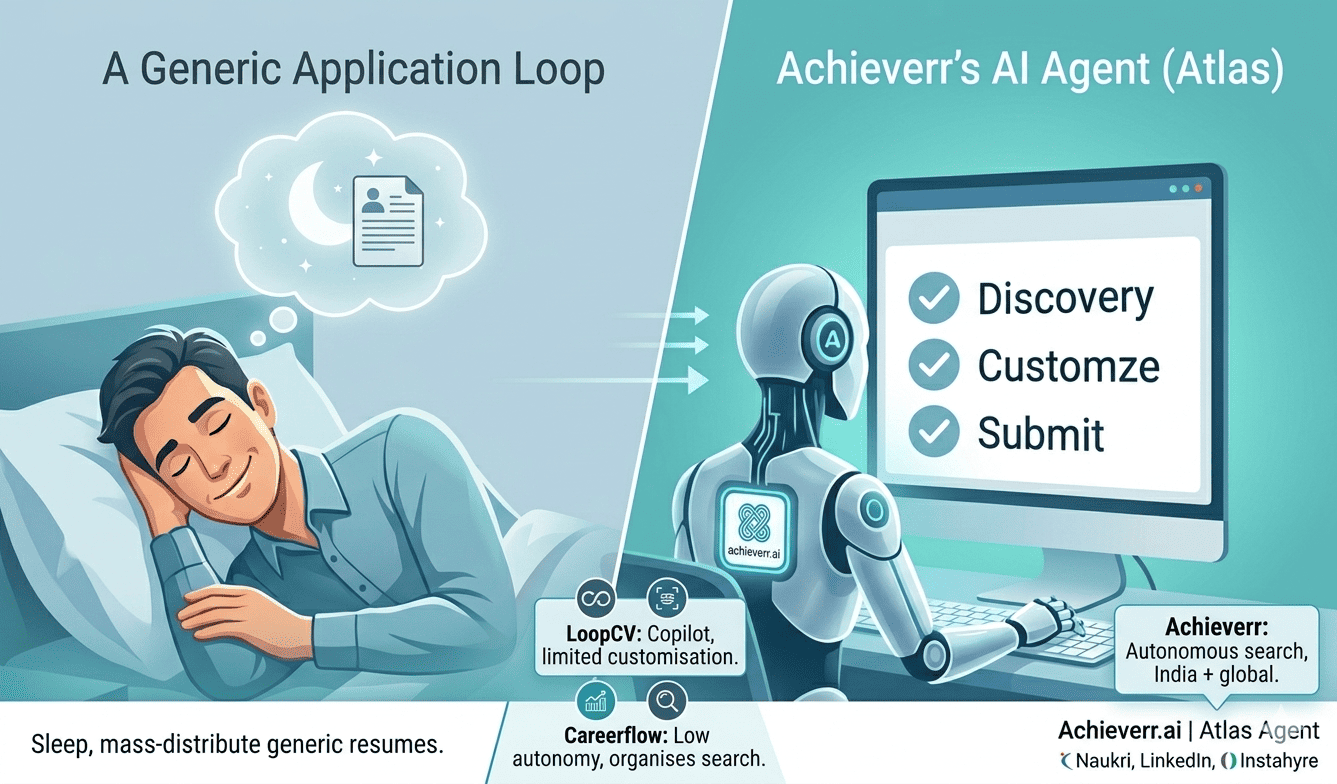
Atlas – Achieverr’s AI career agent was built specifically for the autonomy gap. The design principle is that you configure it once and it runs. Not ‘runs when you click apply.’ Just runs.
The three things it does that LoopCV and Careerflow don’t do together:
• Discovers matching jobs across Naukri, LinkedIn, Instahyre, and global boards – without you searching
• Rewrites your resume for each specific role based on the job description’s language and requirements – not keyword stuffing, an actual rewrite
• Submits the application – while you’re at work, asleep, or doing literally anything else
The pricing is also different. INR 199 to INR 499 per month depending on the tier. There’s no demo call required, no enterprise pricing page. You sign up and see the number.
Honest comparison
Feature | LoopCV | Careerflow | Achieverr.ai |
Auto-applies without manual input | Yes | No (copilot) | Yes |
Per-role resume customisation | Basic keyword boost | Manual editing | Full AI rewrite per role |
India job board coverage | Limited | Limited | Naukri, LinkedIn, Instahyre |
Transparent pricing | No (demo required) | Yes ($23.99/mo) | Yes (INR 199-499/mo) |
Setup complexity | Medium | Low | Low |
Best for | Volume, Western markets | Organised search, coaching | Autonomous search, India + global |
Which one should you use?
If you’re based in India and want a fully autonomous job search – meaning you want to configure it once and have applications go out while you focus on other things – Achieverr is the closest fit right now.
If you’re already employed and want to run a careful, organised search where you review every application before it goes out, Careerflow is worth the price.
If your primary goal is raw volume and you’re applying to US/EU markets, LoopCV does that reasonably well at a lower commitment level.
Most people in an active tech job search in India are in the first camp. You don’t have time to review every application. You need the machine running in the background while you prepare for the interviews it generates.
One more thing on pricing
LoopCV’s pricing opacity is worth flagging separately. When a product won’t show you its price without a sales call, you’re usually looking at INR 3,000–8,000/month minimum once you factor in the conversion push. That’s a meaningful number if you’re job-seeking and not currently earning.
Save valuable time and effort spent searching for a solution.
Turn on Atlas now — because opportunities won’t wait around